


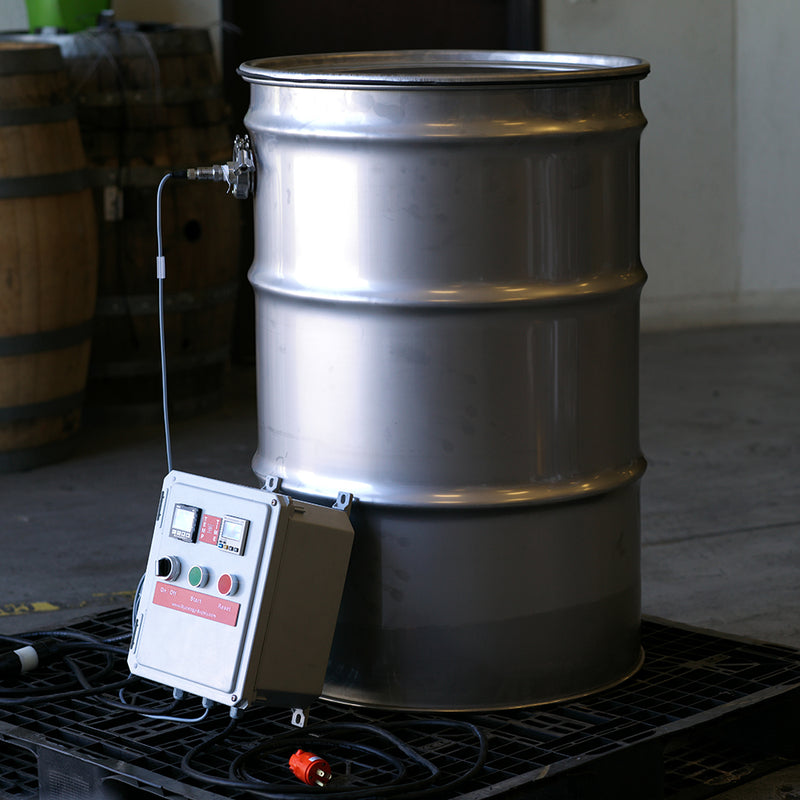
55-Gallon Barrel Steamer for Mushroom Substrate Pasteurization
The 55-Gallon
Barrel Steamer
Load it. Press start. Walk away. Process 200 lb of substrate per cycle with PID-controlled atmospheric steam — at half the labor cost of an autoclave.
Why Super Pasteurization Matters
Contamination is a race. The slower your species colonizes, the cleaner your substrate needs to be. Simple pasteurization won't cut it for slow colonizers.
The Colonization Race
Fast colonizers like oyster mushrooms fully colonize straw in 2–3 weeks, outrunning competitors on minimally pasteurized substrate. Slow colonizers — shiitake (6–8 weeks), lion's mane (4–6 weeks), and specialty strains (8–10 weeks) — face weeks of vulnerability where surviving contaminants can establish and overtake the substrate.
Wake & Kill Mechanism
At atmospheric pressure, the barrel steamer maxes out near 100°C. To compensate, the substrate is held at 95–100°C for 12–24 hours. This extended heat triggers germination of dormant endospores — the most heat-resistant microbial structures — then kills the vulnerable vegetative cells. This repeated cycle eliminates the vast majority of microbial life.
F₀ Lethality Data
Our instrumented run achieved 83% of the 12D C. botulinum F₀ target (2.09 of 2.52 min). The hold phase accumulated lethality at 0.22 F₀-min/hr. Extending the hold by just ~2 hours reaches the full 100% target — which is why we recommend a 14-hour PID timer setting for maximum safety.
The 6-Hour Thermal Lag
The most critical finding: substrate core temperature lags steam by 6.12 hours. When your steam reaches 96.5°C at hour 3, the substrate core is still only at ~65°C. Timer settings must account for this lag — a 12-hour timer provides only ~6 hours of effective hold at the substrate core.
Match Treatment to Species
The slower the colonizer, the more aggressive your substrate preparation must be.
| Species | Colonization | Recommended Treatment | Rationale |
|---|---|---|---|
| Oyster (Pleurotus) | 2–3 weeks | Pasteurization | Aggressive colonizer outpaces competitors |
| Wine Cap (Stropharia) | 3–4 weeks | Pasteurization | Vigorous outdoor species |
| Lion's Mane (Hericium) | 4–6 weeks | Super Pasteurization | Moderate-slow, sensitive to competition |
| Shiitake (Lentinula) | 6–8 weeks | Super Pasteurization | Slow colonizer on supplemented substrates |
| Reishi (Ganoderma) | 4–8 weeks | Super Pasteurization | Slow, benefits from near-sterile conditions |
| P. cubensis (standard) | 4–6 weeks | Super Pasteurization | Slow colonizer on nutrient-rich substrate |
| P. cubensis (Penis Envy) | 8–10 weeks | Super Pasteurization | Extremely slow — maximum hold time recommended |
10,024 Data Points.
Zero Guesswork.
Dual Type-K thermocouple probes recorded steam and substrate core temperatures every 15 seconds over 43.5 hours. Here's what the data says.
Four Phases of a Steamer Cycle
From cold start to cool-down, every barrel steamer run follows this thermal profile.
Choose Your Configuration
Every barrel steamer includes a false bottom, float valve, and heating element. Upgrade to a PID controller with countdown timer for automated, hands-off operation. Available in carbon steel or stainless steel, 110V or 220V.
Stainless Steel + PID Controller
- ✓ 55-gallon stainless steel barrel
- ✓ Perforated false bottom + spacer grid
- ✓ Float valve auto water level
- ✓ PID controller with countdown timer
- ✓ 5,500W element — 1.3 hr ramp-up
- ✓ Corrosion-proof, no maintenance
Basic Stainless Steel
- ✓ 55-gallon stainless steel barrel
- ✓ Perforated false bottom
- ✓ Float valve auto water level
- ✓ Simple on/off switch operation
- ✓ No painting required
- ✓ 200 lb substrate capacity
Carbon Steel + PID Controller
- ✓ 55-gallon carbon steel barrel
- ✓ Perforated false bottom + spacer grid
- ✓ Float valve auto water level
- ✓ PID controller with countdown timer
- ✓ 5,500W element (220V: $2,250)
- ✓ Tri-clamp ports, modified lid
Basic Carbon Steel
- ✓ 55-gallon carbon steel barrel
- ✓ Perforated false bottom
- ✓ Float valve auto water level
- ✓ Simple on/off switch operation
- ✓ 1,600W heating element (110V)
- ✓ 200 lb substrate capacity
All units made to order. Typical lead time: 2–4 weeks. Ships by freight. Optional heavy duty dolly available (+$250).
Barrel Steamer vs. Autoclave
Same 1,000 lb/week throughput. Different economics. The barrel steamer's "load and walk away" model halves labor costs — saving $3,646/year.
- Substrate / cycle200 lb
- Cycle time24.6 hr
- Cycles / week5
- Weekly handling events5
- Energy / run$1.31
- Annual labor (@ $25/hr)$3,250
- Substrate / cycle100 lb
- Cycle time9.0 hr
- Cycles / week10
- Weekly handling events10
- Energy / run$1.03
- Annual labor (@ $25/hr)$6,500
TCO based on 1,000 lb/week, 5-day work week, $25/hr labor, $0.15/kWh energy. Steamer: 1 cycle/day. Autoclave: 2 cycles/day. Equipment amortized over 3 years.
PID Timer Settings
The timer = hold time. It counts down after steam stabilization. The substrate core lags by ~6 hours, so a 12-hour timer provides ~6 hours of effective core hold.
| PID Timer | Core Hold Time | Pasteurization Level | Best For |
|---|---|---|---|
| 7 hr | ~1 hr | Simple Pasteurization | Oysters & fast colonizers on low-nutrient substrates |
| 9 hr | ~3 hr | 25% Super Pasteurization | Minimum for supplemented substrates |
| 10 hr | ~4 hr | 50% Super Pasteurization | Moderate-risk species on supplemented substrates |
| 12 hr | ~6 hr | 75% Super Pasteurization | ★ Good for most slow colonizers |
| 14 hr | ~8 hr | 100% Super Pasteurization (12D) | ★ RECOMMENDED for slowest colonizers & highest contamination risk |
Loading Your Barrel
Air gaps are everything. Without proper steam circulation, cold spots form — the #1 cause of contamination in barrel steamer operations.
Outer Ring
Stack bags around the barrel's outer edge with space between each bag for steam circulation.
Brick-Lay Pattern
Offset each layer from the one below for stability and maximum airflow between bags.
Center Fill
Place an additional stack in the center, leaving a gap between center and outer ring.
Continue Stacking
Repeat the brick-lay pattern to the top, maintaining air gaps at every level.
Probe Clearance
Never cover the steam probe. It must read accurate steam temperature for PID control.
Seal & Start
Seat the insulated lid firmly. Verify the steam vent is unblocked. Press start.
How Many Barrels Does Your Farm Need?
With a 46-day residency per bag (2 days prep, 28 days colonize & first flush, 14 days second flush, 2 days cleanup), a single barrel supports hundreds of bags in rotation.
Production per load: 66 bags (3 lb), 40 bags (5 lb), or 20 bags (10 lb). 1 cycle/day, 5-day work week, 6.6-week residency.
Frequently Asked
Start Processing 1,000 lb/week
with a Single Barrel
Every unit is made to order in Northern California. Call to discuss your setup, substrate type, and production goals before ordering.