


Julian Day Clock — Track Cultivation Times Without Calendar Math | Mycology Supply
The Simplest Way to Track Every Batch.
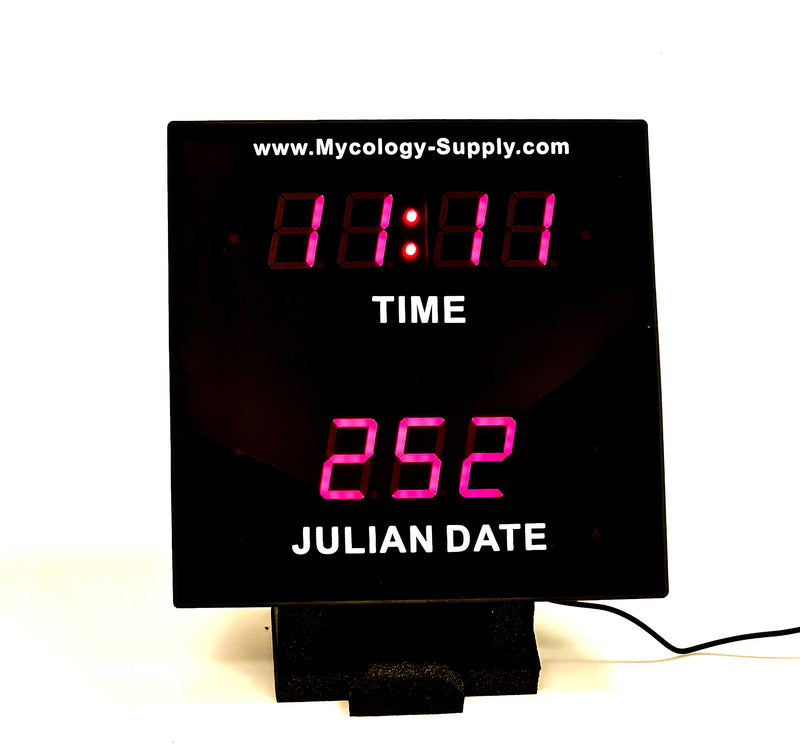
A digital clock that displays the day of the year — eliminating calendar math from your inoculation and cultivation tracking forever.
Only $68 — In stock, ships fast
Why Calendar Dates Don't Work for Cultivation
You inoculate grain on March 15. Colonization takes 21 days. When do you check? You count days remaining in March, then carry over into April — every time, for every batch.
Now manage six batches at different stages. The overhead compounds fast.
Without Julian days
Inoculate March 15.
Add 21 days.
March has 31... so 16 left, then 5 into April...
April 5.
Repeat for every batch.
With a Julian Day Clock
Inoculate Day 74.
Add 21.
Check Day 95.
Every time. No math.
One Number. All Year.
The Julian day system counts every day of the year as a single continuous number. January 1 is Day 1. February 1 is Day 32. December 31 is Day 365. The clock displays both the current time and this day number — always on your bench.
Glance at the clock, note the day number
Inoculate a batch. The clock shows Day 87. That's your reference — no calendar needed.
Add your expected days
Colonization takes 18–21 days? Check between Day 105 and Day 108. That's the entire calculation.
Track every batch the same way
Six batches at six different stages. Each has a day number. Comparing timelines, planning harvest windows, catching slow colonizations — all instant arithmetic.
What You'll Track at a Glance
Grain Colonization
Inoculation day to check day
Substrate Blocks
Multiple batches, no confusion
Fruiting Timelines
Pin to harvest intervals
Liquid Culture
Age and viability tracking
Built for the Bench.

Julian Day vs. Calendar Dates
Julian Day System
✅ Every day has one unique number
✅ Elapsed time is always simple addition
✅ No month-boundary confusion
✅ Multi-batch tracking is effortless
✅ Used by astronomers, food production & cultivators
Calendar Dates
❌ Months have different day counts
❌ Elapsed time requires mental arithmetic
❌ Easy to miscalculate across months
❌ Tracking multiple batches gets messy
❌ More cognitive overhead at every step
Frequently Asked
Does it show the time as well as the day?
Yes — it's a full digital clock. It displays both the current time of day and the Julian day number. One device, two pieces of information, always on your bench.
Do I need to reset it at the start of each year?
No — it resets automatically on January 1. You don't need to do anything.
What if a batch spans New Year's?
For the few days around year-end when a batch spans the transition, a little simple mental math handles it. It's a rare edge case and easy to manage.
Is this only useful at commercial scale?
Not at all. If you're managing even two or three batches at once, the overhead of tracking calendar dates adds up. Julian day notation removes it at any scale — hobby or commercial.
Is it useful beyond grain work?
Yes. Substrate prep, fruiting timelines, harvest intervals, liquid culture aging — any time-sensitive process in your grow room benefits from Julian day tracking.
Stop Doing Calendar Math in Your Head.
$68 — in stock and ships fast.
In stock • Ships fast • Mycology-Supply, Northern California